
INTRODUCTION
When I mention servant leadership in a steering committee, I can predict the response with near-perfect accuracy.
Someone will smile politely. Someone else will nod. And at least one person will think, privately or aloud, that servant leadership is for team-building workshops and leadership retreats not for managing billion-dollar transformations under board pressure with a go-live date that cannot move.
I understand the skepticism. In enterprise transformation, the conventional wisdom is that authority drives outcomes. Clear hierarchy. Decisive top-down direction. Strong program managers who get things done by will and position power.
The data tells a different story consistently, across industries, and with implications that are particularly acute in the age of AI.
Programs led by servant leaders succeed at measurably higher rates. Teams in servant-led environments adopt new systems faster, resist change less, and sustain transformation results longer. The correlation between servant leadership and transformation outcomes is not correlation in program after program, it is causation.
This article explains why. And it explains why AI makes servant leadership not optional, but essential.
What Servant Leadership Actually Means in a Transformation Context
Servant leadership, as a leadership philosophy, originates with Robert Greenleaf's 1970 essay 'The Servant as Leader.' But the corporate interpretation of servant leadership has drifted significantly from what actually drives results in enterprise programs.
Servant leadership in transformation does not mean:
• Making everyone comfortable all the time
• Avoiding difficult conversations or decisions
• Treating the program as a democracy
• Prioritizing team feelings over program outcomes
• Declining to escalate or enforce accountability
What servant leadership does mean specifically in the context of enterprise transformation is leading from a place of genuine investment in the success of your team, your stakeholders, and the organization, rather than from a place of personal status, authority, or self-protection.
The distinction matters enormously in practice. Here is what it looks like on a real program:
Servant Leaders Remove Obstacles
A traditional command-and-control program manager holds accountability above the team they measure, report, and escalate. A servant leader sits between the team and the obstacles that are preventing the team from succeeding and spends their primary energy removing those obstacles.
On enterprise programs, the most expensive problems are not technical. They are organizational cross-functional alignment failures, resource conflicts that nobody has the authority to resolve, decisions that sit in governance limbo for weeks because nobody wants to own them. Servant leaders resolve these. They spend their political capital on behalf of their team rather than preserving it for themselves.
Servant Leaders Build Psychological Safety
Enterprise transformations surface bad news constantly. Data that is worse than expected. Milestones that will be missed. Assumptions that were wrong. In a command-and-control environment, bad news travels slowly upward because nobody wants to be the one who delivers it.
In a servant-led program environment, bad news travels fast because the team knows the program leader's response to bad news is to help solve the problem, not to look for someone to blame.
This is not a soft benefit. It is the single most important driver of early risk detection which is the single most important factor in whether a program recovers from problems or is consumed by them.
Servant Leaders Sustain Adoption
Go-live is the moment when transformation programs transition from delivery to adoption. The people who determine whether an organization actually changes its behavior or reverts to old ways within 90 days are the end users and front-line managers who were either brought along through the transformation or were not.
Servant-led transformation programs invest systematically in those relationships. The result is dramatically better adoption curves and significantly fewer post-go-live support escalations.
The Data Behind Servant Leadership and Transformation Outcomes
The research base for servant leadership and organizational outcomes is substantial. Here are the numbers most relevant to enterprise transformation: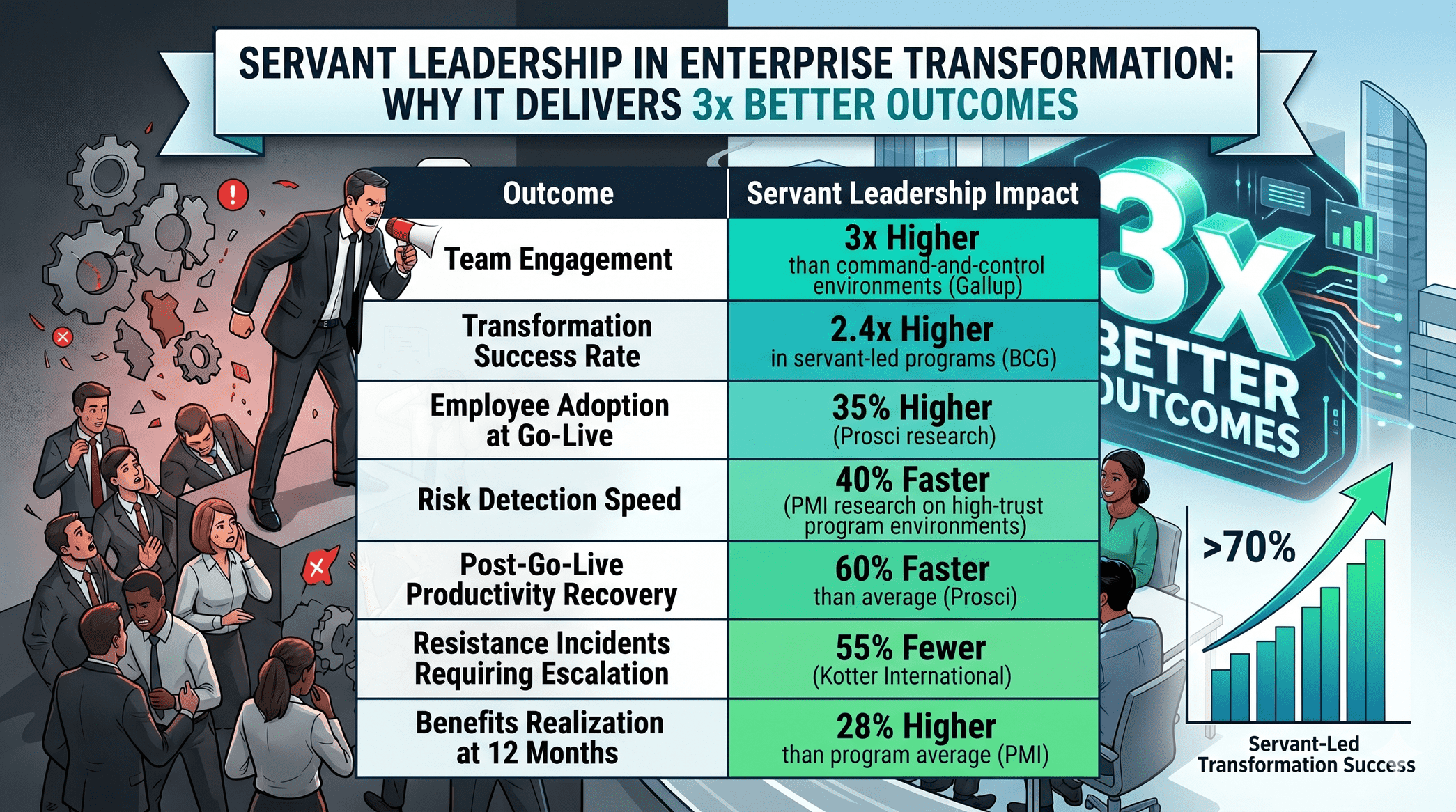
The Data Behind Servant Leadership and Transformation Outcomes
These are not marginal improvements. A 2.4x higher transformation success rate in a landscape where 65–70% of transformations fail is the difference between building something that lasts and spending three years producing a $40 million write-off.
Why AI Makes Servant Leadership More Important, Not Less
This is the insight that most leadership conversations about AI in the enterprise miss entirely.
AI is not just changing what program managers do. It is changing the psychological contract between transformation leaders and their teams.
When AI automates the routine elements of a project manager's job status reporting, risk flagging, task assignment, meeting documentation what remains is judgment, relationship, and leadership. These are not AI-replaceable capabilities. They are the core of what a Transformation Architect actually does.
But AI in the enterprise also creates a specific form of team anxiety that servant leaders are uniquely positioned to address: the fear that AI is evaluating, judging, or replacing the humans it is working alongside.
The Three AI-Era Servant Leadership Imperatives
1. Transparency About What AI Is and Is Not Doing
On programs using AI-powered tools for risk monitoring, performance tracking, and adoption sensing, teams will notice that information about their work is being captured and analyzed. Command-and-control leaders tend to treat this as surveillance infrastructure. Servant leaders treat it as a service explaining what the data is used for, how it informs program decisions, and how it is used to help the team succeed, not to judge them.
The difference in team response is significant. Servant leaders who demystify AI tools see faster adoption and less resistance. Leaders who keep the AI infrastructure opaque see exactly the opposite.
2. Protecting Human Judgment in AI-Augmented Programs
AI tools can produce outputs that are impressive and wrong simultaneously. A risk analysis that surfaces 47 risks with apparent precision is only valuable if a human with judgment reviews it and separates the signal from the noise. A change impact heat map is only actionable if someone who knows the organization reads it in context.
Servant leaders establish and protect the discipline of human review on all AI outputs. They resist the organizational pressure to accept AI-generated recommendations without scrutiny — because they understand that their team's judgment is not being replaced by AI, it is being exercised on a higher volume of better-quality inputs.
3. Leading Through Role Redefinition
Every major technology transformation changes what people do. AI transformations do this at a pace and scale that previous technology waves did not. Team members who spent the last decade building skills in manual data analysis, status reporting, and document production are watching AI absorb those tasks in real time.
Servant leaders address this proactively. They help team members find their new role in an AI-augmented program environment. They invest in reskilling rather than replacement. They communicate with honesty about what is changing and why.
The result: team members who embrace AI as a tool rather than resisting it as a threat.
Servant Leadership in Practice: What It Looks Like on a Real Program
Servant leadership in enterprise transformation is not an abstract philosophy. It is a set of specific behaviors that can be practiced, developed, and measured.
Weekly 1:1s That Are About the Team Member, Not the Status Update
The most powerful servant leadership practice I have seen on enterprise programs is the commitment to weekly 1:1 conversations with direct reports that begin with one question: what do you need from me this week that you do not have?
This is not a status meeting. It is a support meeting. The program manager's role in this conversation is to listen, remove obstacles, and follow through on every commitment made.
Taking the Hit on Behalf of the Team
On enterprise programs, things go wrong. Steering committees want to know who is responsible. The servant leadership response is to accept accountability at the program level to stand in front of the steering committee and own the problem rather than passing the pressure downward onto the team member who was closest to the issue.
This is not about avoiding accountability. It is about calibrating it correctly. Individual team members should be held accountable for execution within their control. Program leaders should be held accountable for the environment in which execution happens. When program leaders conflate the two, they destroy psychological safety and guarantee that bad news will be hidden from them in the future.
Celebrating the Team, Not Yourself
In fifteen-plus years of enterprise program leadership, I have observed that the program managers who take the most credit for transformation success are consistently the ones whose programs deliver the least sustainable value. And the ones who spend their energy amplifying the work of their teams consistently produce the programs that earn executive sponsorship for the next engagement.
This is not altruism. It is effective leadership strategy. Your reputation in enterprise transformation is built on outcomes. Outcomes are delivered by teams. Teams give their best work to leaders they believe are invested in their success.
Building a Servant Leadership Culture in an AI-Era Transformation
You cannot install servant leadership as a program management process. But you can create conditions that make it the natural mode of operation:
1. Model the behavior explicitly: State in program kickoff that your leadership philosophy is servant leadership. Explain what it means. Give team members permission to hold you accountable to it.
2. Build psychological safety structures: Establish mechanisms for bad news to travel fast no-blame retrospectives, open risk logs, protected escalation channels.
3. Invest in people with the same rigor you invest in technology: Budget for change management, training, and adoption support at the level the research recommends not at the level that feels comfortable to your steering committee.
4. Connect AI tools to team success, not team surveillance: Frame every AI deployment in terms of what it does for the team, not what it does for the governance layer.
5. Protect human judgment explicitly: Make it a program standard that all AI outputs are reviewed by qualified humans before entering governance. Make the review process visible and valued.
Servant leadership is not a soft alternative to strong program management. It is what strong program management looks like when the objective is lasting transformation not just a go-live date.
The Leadership Model for the Age of AI
The enterprise transformation leaders who will define the next decade are not the ones who can manage the most complex schedules or produce the most impressive steering packs. They are the ones who can build human organizations that perform at their best in environments of high AI capability, high uncertainty, and high organizational stakes.
That is servant leadership. It is not soft. It is the hardest thing you will do as a transformation leader and it is the thing that makes everything else work.
The data is clear. The methodology is available. The only question is whether you are willing to practice it consistently under pressure.
Programs led by servant leaders succeed at 2.4x the rate of those that are not. In a market where 65–70% of transformations fail, that is the most important performance lever available to you.
[ Read: Servant Leadership Is Not Soft — It's the Hardest Thing a Transformation Leader Can Do ]
[ Explore the AI Project Manager Certification ]
[ Download the Free Transformation Leadership Framework ]