INTRODUCTION
The PMP (Project Management Professional) certification from PMI has been the gold standard for project management credentials for over two decades. It is rigorous, globally recognized, and a baseline requirement for senior PM roles at most Fortune 500 companies.
The AMIGA Framework is something different. It is not a certification body. It is not a PMI competitor. It is a complete enterprise transformation methodology developed specifically for the AI era — and it is becoming the framework of choice for transformation leaders who want to move beyond project management and into the $250K–$350K+ Transformation Architect tier.
If you are trying to decide where to invest your professional development time and money, this article gives you an honest, straight-talking comparison.
The short answer: you probably need both, but for very different reasons and at different stages of your career.
What Is PMP?
The Project Management Professional (PMP) certification is issued by the Project Management Institute (PMI) and is based on the PMBOK Guide (Project Management Body of Knowledge).
PMP validates that a practitioner has the foundational knowledge, vocabulary, and process discipline to manage projects across industries. It covers the full project lifecycle initiating, planning, executing, monitoring and controlling, and closing and is applicable to both predictive (waterfall) and agile delivery approaches.
What PMP Does Well
• Establishes a common professional language across industries and geographies
• Validates competency in scope, schedule, budget, quality, risk, and communication management
• Provides credibility with HR systems and hiring managers who screen for recognized credentials
• Covers Agile and hybrid delivery approaches through the recent PMBOK 7 updates
• Is recognized in 214 countries genuinely global currency
Where PMP Has Gaps
• Designed for managing projects, not architecting enterprise transformations
• No coverage of AI integration in program management
• Minimal treatment of benefits realization the post-go-live phase where most value is lost or captured
• Governance model designed for single-project contexts, not multi-workstream enterprise programs
• No methodology for orchestrating human-AI teams
• Data management and migration risk not addressed at enterprise scale
PMP is the essential credential for establishing project management credibility. It is not designed for the scale and complexity of enterprise transformation in 2026.
What Is the AMIGA Framework?
AMIGA (Adaptive Management and Integration for Governed Advancement) is a six-dimension enterprise transformation methodology developed by Rick Catalano after 30 years leading programs from $12 million implementations to nine-figure global transformations.
Its six dimensions — People, Process, Technology, Data, Governance, and Value — provide a complete architecture for planning, executing, and delivering measurable value from enterprise-scale programs.
What AMIGA Does Well
• Provides a complete execution methodology for enterprise transformation not just a framework for thinking about it
• Addresses all six dimensions that determine transformation success, not just the traditional three (People, Process, Technology)
• Maps 260+ AI use cases across every transformation discipline
• Includes a full benefits realization methodology from business case through post-go-live value tracking
• Designed for AI-era governance: decision architectures that function at the speed AI-driven programs require
• Integrates directly with the AMIGO platform for AI-powered program management
• Built on real enterprise experience, not academic frameworks or consultant theorizing
Where AMIGA Has Gaps
• Less recognized by HR systems that screen for traditional credentials (PMP, PRINCE2)
• Not suited for small, single-project delivery contexts it is designed for enterprise scale
• Steeper learning curve for practitioners without prior enterprise transformation exposure
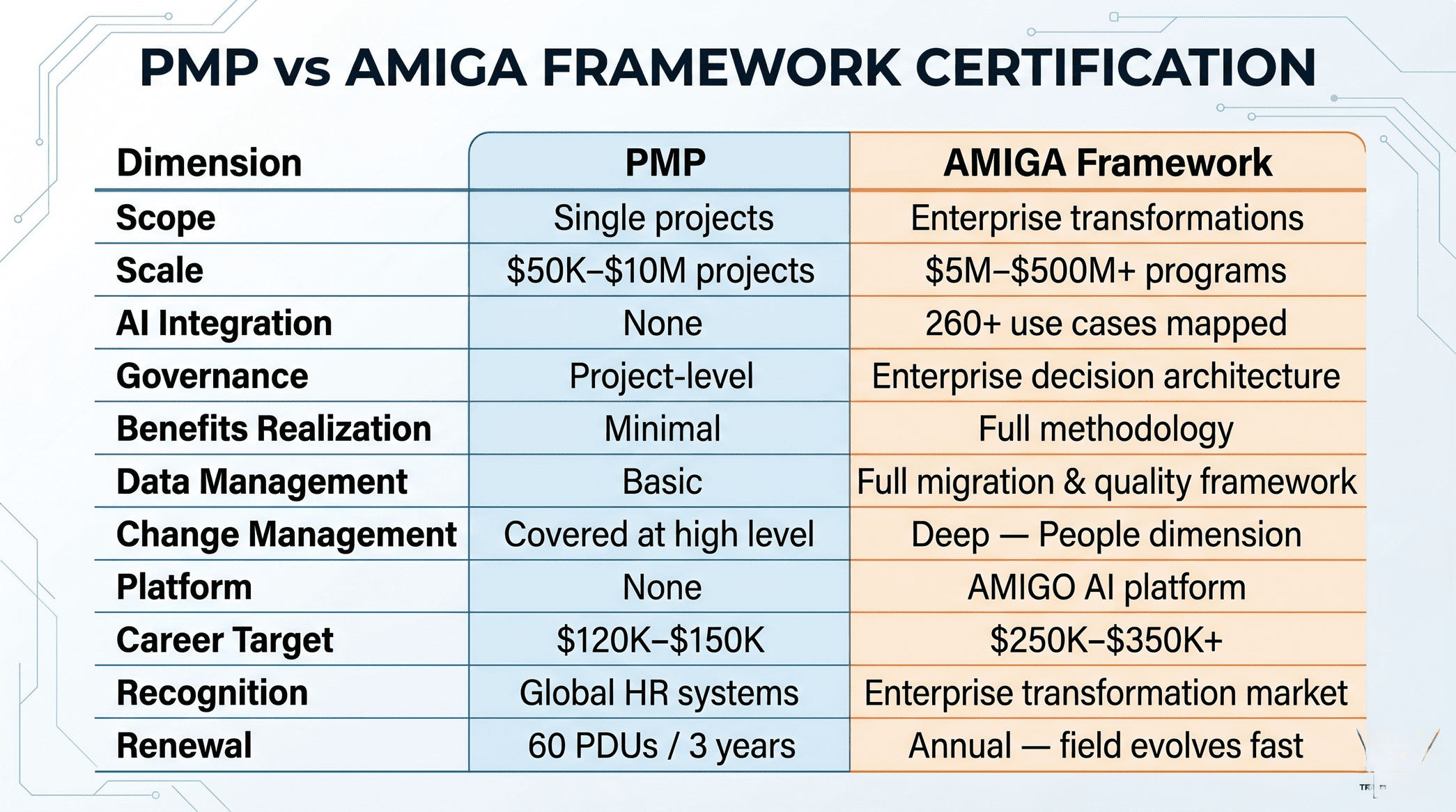
Side-by-Side Comparison
The Real Question: Which One Do You Need?
This is where most comparison articles get it wrong. PMP and AMIGA are not alternatives. They are tools for different problems at different career stages.
You Need PMP If:
• You are earlier in your project management career (0–8 years experience)
• You are applying for roles at organizations with formal HR credential screening
• You manage projects in the $50K–$5M range
• You need to demonstrate foundational PM competency to external stakeholders
• You are building your credential portfolio before moving to enterprise transformation
You Need the AMIGA Framework If:
• You have 8+ years of PM experience and are ready for enterprise-scale programs
• You want to move into the $250K–$350K+ Transformation Architect tier
• You are leading or preparing to lead a $10M+ transformation program
• You need a complete methodology, not just a credential
• You want to integrate AI systematically into how you run programs
• You are building a consulting practice around enterprise transformation
You Need Both If:
• You want maximum career flexibility PMP for institutional credibility, AMIGA for execution capability
• You work in environments where HR screens for PMP but your actual work is enterprise transformation
• You are building a long-term career in transformation leadership
The most successful Transformation Architects I know hold PMP for credibility and operate on AMIGA for execution. They are not in competition with each other — they serve different audiences at different moments in the hiring process.
What About Other Frameworks? PRINCE2, SAFe, PROSCI
The enterprise transformation landscape has several other credentials worth briefly addressing:
• PRINCE2: Strong governance orientation, widely recognized in the UK and Europe. Like PMP, designed for project management rather than enterprise transformation. Valuable foundational credential.
• SAFe (Scaled Agile Framework): Excellent for technology delivery at scale. Does not address the full transformation scope governance, data, benefits realization, change management at enterprise level.
• PROSCI (Change Management): The gold standard change management credential. Excellent as a complement to AMIGA - PROSCI handles the people science, AMIGA integrates it into the full transformation architecture.
• TOGAF (Enterprise Architecture): Valuable for IT-heavy transformation roles. Addresses technology architecture well; less coverage of program execution, change management, and benefits realization.
None of these frameworks address what AMIGA addresses: the complete system for planning, executing, and delivering value from enterprise AI-era transformation.
The Career Math
The credential investment question always comes down to ROI. Here is the math for a senior PM considering both credentials:
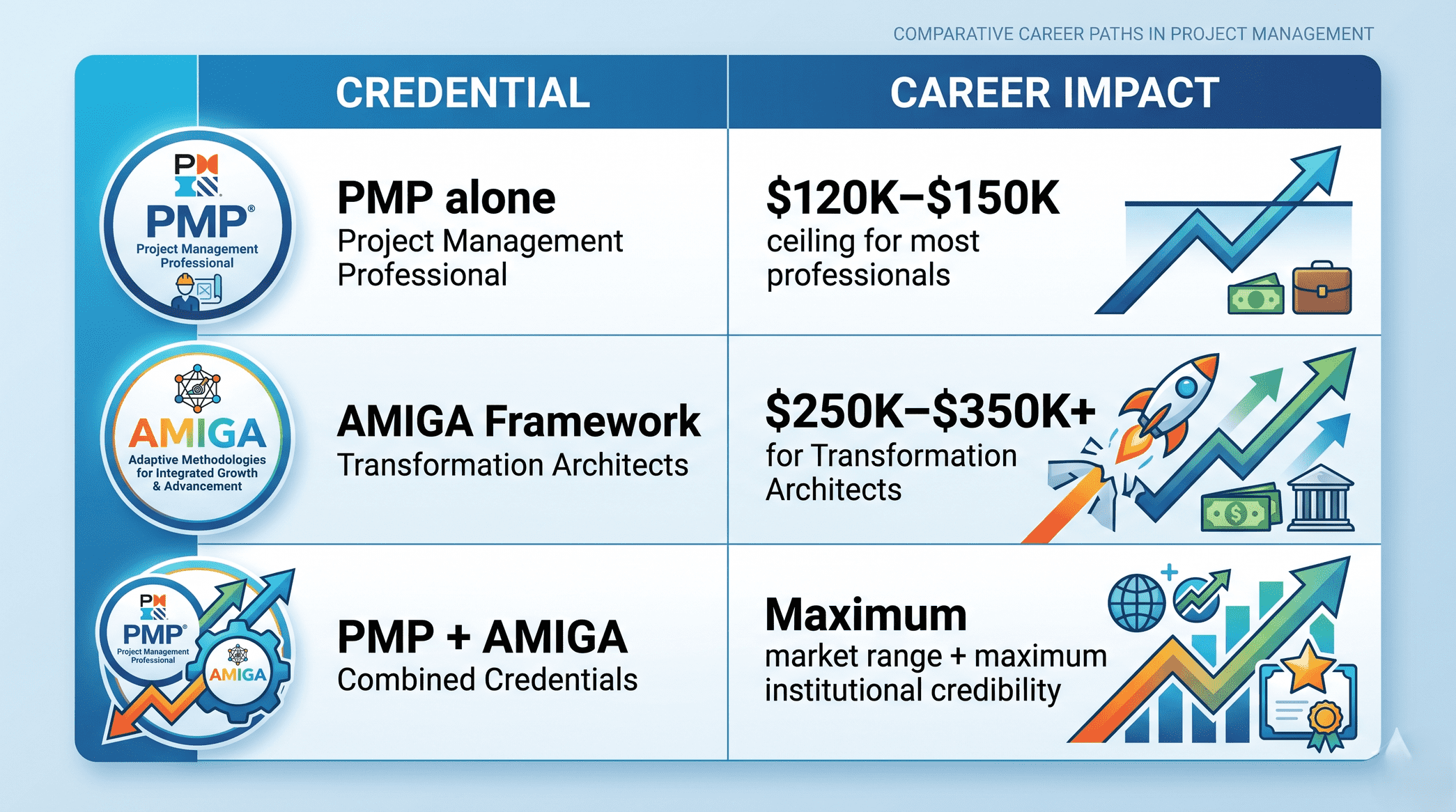
A comparative table outlining three career paths within project management, highlighting the potential career impact, including salary and institutional credibility, associated with different credential combinations.
The demand for Transformation Architects who combine rigorous methodology with genuine AI fluency significantly exceeds supply in the USA market right now. Organizations running nine-figure programs are paying premium compensation to find leaders who have both.
PMP proves you can manage. The AMIGA Framework proves you can transform. In 2026, the market pays a significant premium for the latter and a combination of both is the strongest positioning available.
How to Get Started with the AMIGA Framework
The AMIGA Framework is taught in the AI Project Manager Certification Program at theaiprojectmanager.ai. The certification covers all six dimensions, includes access to the AMIGO AI platform, and provides the complete toolkit for operating at Transformation Architect level.
If you are PMP-certified and want to move to enterprise transformation leadership, the AI PM Certification program is the natural next step.