SAP serves over 296,000 customers across 190 countries. Oracle has powered the back-office operations of some of the world's largest organizations for decades. Workday has redefined cloud HR for thousands of enterprises. These platforms are mature, proven, and backed by armies of implementation consultants.
And yet, over 43% of ERP implementations are still delivered late, over budget, or fail to meet their objectives.
If the technology isn't the problem, what is? After thirty years of leading ERP and enterprise system implementations, I've identified three root causes that account for the overwhelming majority of failures none of which appear on any software vendor's implementation roadmap.
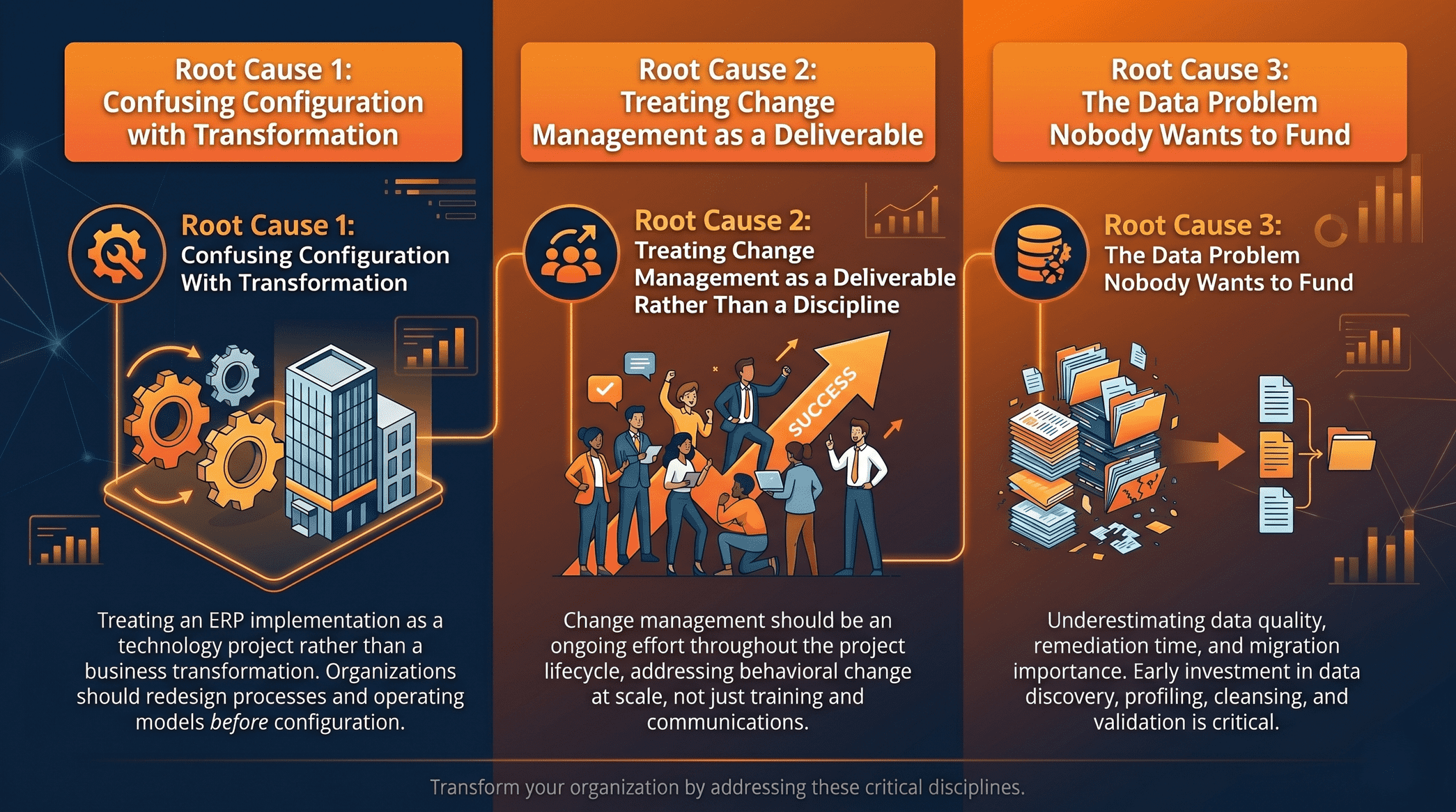
An infographic breaking down the top reasons for ERP project failure into three key categories: treating it as a technical config project instead of business transformation, mismanaging change as a one-time deliverable, and underfunding critical data management work.
Root Cause 1: Confusing Configuration With Transformation
The most common ERP failure pattern I encounter starts with a fundamental category error: treating an ERP implementation as a technology project rather than a business transformation.
When organizations treat ERP as a technology deployment, they hand the program to IT. IT delivers on scope, schedule, and budget and the business discovers at go-live that the new system faithfully executes the same broken processes they were running before, just at higher speed.
ERP implementations that succeed treat the system as an enabler of business change, not the change itself. Process redesign, organizational restructuring, and operating model definition must precede not follow system configuration. This reordering of priorities feels counterintuitive to technical teams, but it is the single most important discipline that separates transformational ERP programs from expensive system migrations.
Root Cause 2: Treating Change Management as a Deliverable Rather Than a Discipline
Most ERP programs have a change management workstream. Most of those workstreams produce training materials, communications plans, and readiness assessments. Then they declare victory.
Real change management isn't a deliverable it's an ongoing discipline that runs from program inception through post-go-live sustainment. It asks: Who in this organization needs to change what they do, and how do we actually get them there?
The answer is never training alone. Behavioral change at scale requires clear communication of why, visible executive sponsorship, manager-led reinforcement, and a feedback loop that surfaces and addresses resistance before it becomes sabotage.
Organizations effective at organizational change management are six times more likely to meet their transformation objectives. Yet change management budgets typically represent 3-5% of total program investment a ratio that guarantees underperformance.
Root Cause 3: The Data Problem Nobody Wants to Fund
Ask any experienced ERP program leader what keeps them up at night before go-live, and the answer is almost always data.
Organizations consistently underestimate how poor their data quality is, how long remediation takes, and how catastrophically bad data migrated into a new system destroys organizational confidence. Finance can't close the books. Inventory figures are irreconcilable. Customer records are duplicated across three different names.
The problem isn't that organizations don't know data matters. The problem is that data migration is unglamorous, technically demanding work that competes for funding and attention with the more visible aspects of system configuration. Programs that adequately invest in data discovery, profiling, cleansing, and validation consistently achieve better outcomes. Those that treat data migration as a late-stage technical task consistently suffer for it.
The irony is that these three root causes are entirely predictable and therefore entirely preventable. They are not technology failures. They are leadership and planning failures. And addressing them requires not better software, but better disciplines.
Ready to lead transformation at the highest level?
Get your copy of The AI Project Manager: A Transformation Leader's Guide to Enterprise Success on Amazon today:
https://www.amazon.com/Project-Manager-Successful-AI-Enabled-Transformation/dp/B0GRGW6TCD/ref
And visit theaiprojectmanager.ai for free resources, assessments, and the AI Project Manager Certification Program.