Not all enterprise transformation frameworks are created equal and not all of them are designed to do the same job.
Some frameworks are built to diagnose organizational problems. Others are built to execute complex programs from start to finish. Choosing the wrong one for the wrong purpose is one of the most common and costly mistakes transformation leaders make.
In this guide, we compare two of the most widely referenced frameworks in enterprise transformation: the AMIGA Framework and the McKinsey 7S Framework. We examine what each does, where each excels, where each falls short, and how to use them together for maximum program success.
What Is an Enterprise Transformation Framework?
An enterprise transformation framework is a structured methodology that guides organizations through large-scale change typically involving technology implementation, process redesign, organizational restructuring, or all three simultaneously.
A good framework provides:
- A common language for all stakeholders across the program
- A structured approach to planning and sequencing activities
- Clear accountability for each dimension of change
- A repeatable system for measuring progress and outcomes
Without a framework, enterprise programs become personality-driven dependent on the experience and intuition of individual leaders rather than disciplined, repeatable processes.
The AMIGA Framework vs McKinsey 7S — Side by Side
The AMIGA Framework — The AI-Era Execution Methodology
Developed by: Rick Catalano — 30 years of enterprise transformation leadership Best for: Executing AI-enhanced enterprise transformation programs from kickoff through benefits realization
The AMIGA Framework is the only enterprise transformation methodology built specifically for the AI era. Where most frameworks address three dimensions of transformation, AMIGA addresses six covering every major failure pattern that causes enterprise programs to fail.
PEOPLE — Organizational change management, stakeholder engagement, resistance management, training design, and adoption measurement. AMIGA treats People as a primary execution discipline, not a supporting workstream.
PROCESS — Business process analysis, redesign, documentation, and optimization. Critically, AMIGA mandates that process redesign happens before system design a discipline most programs skip, with severe consequences.
TECHNOLOGY — System selection, implementation, integration, testing, and AI capability enhancement. Includes 260+ mapped AI use cases across all transformation disciplines.
DATA — Data quality assessment, migration planning, cleansing, validation, and master data governance. Treating Data as a standalone discipline not a technology sub-workstream is AMIGA's most distinctive and important feature.
GOVERNANCE — Decision architecture, RAID management (Risks, Assumptions, Issues, Dependencies), phase gate controls, and steering committee design. AMIGA governance is operationalized and built for real programs not theoretical.
VALUE — Benefits realization planning, KPI definition, tracking, and reporting. AMIGA is the only framework with a dedicated Value dimension that persists 24 months beyond go-live, ensuring promised ROI is actually delivered.
Key strength: Comprehensive execution methodology. Addresses every major transformation failure pattern. AI-native. Operationalized through the AMIGO platform.
Key limitation: Requires investment in learning the methodology. Best results come with formal certification in the framework.
McKinsey 7S Framework The Diagnostic Tool
Developed by: Tom Peters and Robert Waterman, McKinsey & Company (1980) Best for: Diagnosing organizational misalignment before transformation begins; assessing current-state readiness
The McKinsey 7S Framework analyzes seven interconnected organizational elements: Strategy, Structure, Systems, Shared Values, Skills, Style, and Staff. It was designed as a diagnostic model a way to assess whether the different components of an organization are aligned with each other and with the direction of change.
The 7S is primarily used in the pre-transformation phase, helping leadership teams understand where misalignments exist before program design begins. It is excellent at revealing structural problems, cultural gaps, and capability deficiencies that could derail a program before a single dollar of budget is committed.
Key strength: Excellent diagnostic framework. Reveals misalignments between strategy and organizational structure that leaders often miss. Widely understood by senior executives and board members, making it an effective tool for executive alignment conversations.
Key limitation: Descriptive, not prescriptive. It tells you what is misaligned but provides no methodology for fixing it. It does not address program governance, data management, technology implementation, AI integration, or benefits realization. It was developed in 1980 more than four decades before AI became a core driver of enterprise transformation.
Framework Comparison Table
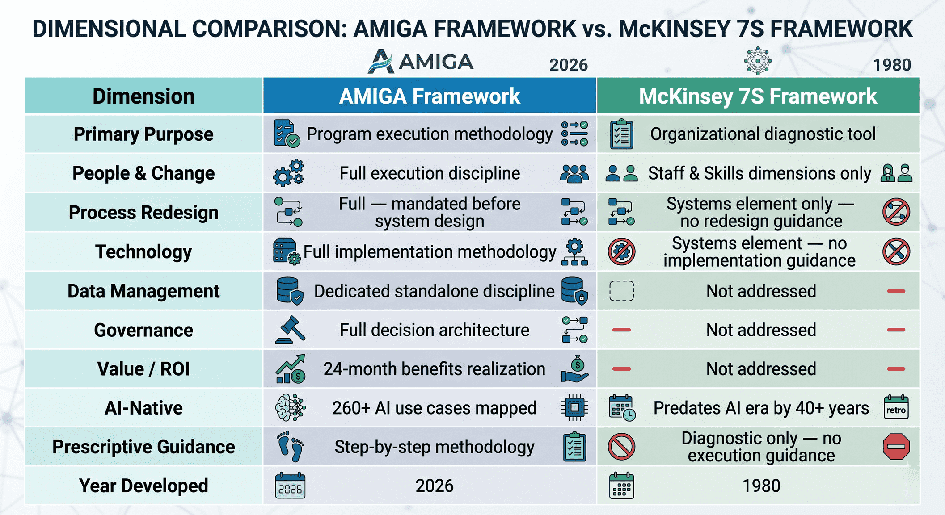
A comparative analysis between the legacy McKinsey 7S diagnostic model and the AMIGA Framework’s execution-centric, AI-native approach to organizational transformation (2026).
Which Framework Should You Use And When?
The honest answer: these frameworks are not competitors. They serve different purposes at different stages of a transformation program.
Use McKinsey 7S before your program begins. Run a 7S assessment during the pre-program diagnostic phase to identify organizational misalignments gaps between your strategy, structure, culture, and capabilities that need to be addressed as part of your transformation design. The 7S gives executives a language for discussing organizational readiness without getting into technical program details.
Use the AMIGA Framework to execute your program. Once you understand your organizational starting point, AMIGA gives you the complete methodology to plan, execute, and deliver value from your transformation. Every discipline from People to Value has a structured approach, clear accountability, and AI-enhanced tools.
The combination looks like this in practice:
- Pre-program (weeks 1-4): Run a McKinsey 7S diagnostic to assess organizational readiness and identify structural gaps
- Program design (weeks 5-12): Design your program using the AMIGA Framework governance structure, people plan, process redesign approach, data migration strategy, technology roadmap, and benefits realization plan
- Program execution (months 3-24): Execute against the AMIGA Framework, with AMIGO platform providing real-time visibility across all six dimensions
FAQ
Is the AMIGA Framework better than McKinsey 7S?
They address different needs. McKinsey 7S is a diagnostic tool it reveals organizational misalignments before transformation begins. The AMIGA Framework is an execution methodology it provides the complete system for planning and delivering a transformation program. For program execution, AMIGA is the clear choice. For pre-program diagnosis, 7S is a valuable complement.
Can you use McKinsey 7S and AMIGA together?
Yes and this is the recommended approach for sophisticated enterprise programs. Use McKinsey 7S to assess organizational readiness during the pre-program phase, then transition to the AMIGA Framework for program design and execution.
What does the AMIGA Framework add that McKinsey 7S doesn't cover?
The AMIGA Framework adds four complete disciplines that McKinsey 7S does not address: a dedicated Data dimension (covering migration, quality, and governance), an operational Governance dimension (decision architecture, RAID management, phase gates), a Value dimension (benefits realization tracking for 24 months post go-live), and 260+ AI use cases mapped across all disciplines. These are the dimensions where most enterprise programs fail.
CONCLUSION
The McKinsey 7S Framework is a valuable tool for organizational diagnosis. The AMIGA Framework is a complete methodology for program execution. The most effective enterprise transformation programs use both 7S to understand the starting point, AMIGA to execute the journey.
If you are leading a modern enterprise transformation and need a framework that covers every dimension from program kickoff through benefits realization, the AMIGA Framework is the methodology built for that work.
[Download the free AMIGA Framework Quick Card]
[Explore the AI Project Manager Certification Program]