Ask any consultant what the keys to successful transformation are, and you'll hear the same answer you've heard for the past three decades: People. Process. Technology.
It's not wrong. Those three elements do matter enormously. But after thirty years of leading enterprise transformations across dozens of industries and hundreds of programs, I've come to understand that this framework is incomplete and its incompleteness is one of the reasons the industry failure rate has stubbornly refused to improve.
The traditional three pillar model leaves out three critical dimensions that modern transformations cannot succeed without: Data, Governance, and Value.
The Case Against the Three Pillar Model
Consider what happens in a typical transformation when you operate only with People, Process, and Technology as your mental model:
You invest in change management (People). You redesign your processes (Process). You implement your technology platform (Technology). You go live. And then often within weeks you discover the data you migrated from is a disaster. Reports don't reconcile. Inventory figures are wrong. Customer records are duplicated or incomplete. The organization loses confidence in the new system almost immediately.
Or consider governance. Programs that operate without a formal governance dimension consistently struggle with decision authority, scope control, and escalation management. Decisions linger for months. Scope expands unchecked. Risks become crises because no one was accountable for catching them early.
Or value. Organizations invest tens or hundreds of millions of dollars in transformation programs, declare victory at go live, and then never actually measure whether the benefits materialize. A staggering 73% of companies fail to measure value from their technology investments. The business case justifies the investment; benefits realization actually captures it. Without a dedicated Value dimension, most programs do the former and skip the latter entirely.
Introducing AMIGA
The AMIGA Framework is built around six integrated dimensions six because each represents a genuine failure vector that transformation leaders must manage simultaneously:
People The human dimension. Change management, training, organizational design, cultural transformation, and the leadership behaviors that create environments where people can genuinely embrace change rather than resist it.
Process The operational dimension. How work actually gets done. Process design, business process management, optimization before technology enablement, and the discipline of not automating dysfunction.
Technology The enabling dimension. The platforms, architectures, and AI capabilities that enable new ways of working. Technology follows process; it doesn't lead it.
Data The intelligence dimension. Data migration strategy, data quality management, master data governance, and treating organizational data as the strategic asset it is. AI makes this dimension more critical than ever garbage in, garbage out at machine speed.
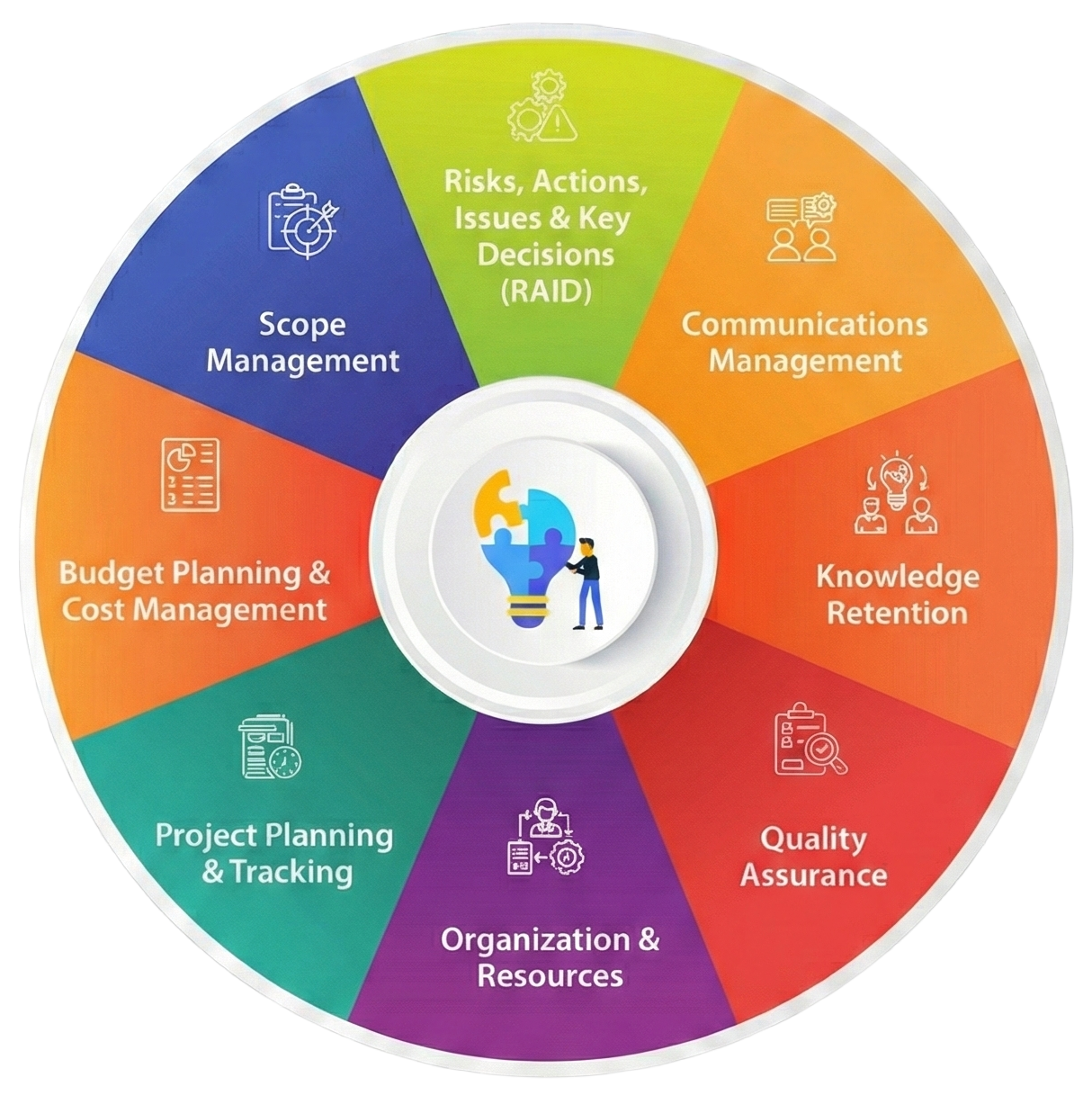
Governance The decision architecture dimension. Program governance, steering committees, decision rights, RAID management (Risks, Actions, Issues, Key Decisions), scope management, and the structures that keep complex programs aligned and accountable.
Value The outcomes dimension. Business case development, benefits design, benefits realization tracking, and the discipline of measuring what the organization actually got for what it invested.
Why Six Dimensions Change Everything
The power of AMIGA isn't in any single dimension, it's in interdependence. Process defines what Technology enables. Data flows through Process. Governance ensures all dimensions stay aligned. Value measures the outcomes of all dimensions working together. People execute everything.
When transformation leaders internalize AMIGA as their operating mental model, they stop thinking about programs as technology deployments and start thinking about them as coordinated, multidimensional change initiatives. That shift in perspective changes how they staff programs, how they structure governance, how they approach data, and how they measure success.
It's also the framework that makes AI integration coherent. AI doesn't just touch Technology it affects all six dimensions simultaneously. It changes how People work. It enables new Process possibilities. It multiplies the value of Data quality. It creates new Governance requirements. And it dramatically expands the Value that can be harvested from transformation.
The organizations building competitive advantage in the next decade will be those that master all six dimensions not just three.
Ready to lead transformation at the highest level?
Get your copy of The AI Project Manager: A Transformation Leader's Guide to Enterprise Success on Amazon today:
https://www.amazon.com/ProjectManagerSuccessfulAIEnabledTransformation/dp/B0GRGW6TCD/ref
And visit www.theaiprojectmanager.ai for free resources, assessments, and the AI Project Manager Certification Program.