I've watched organizations spend $50 million implementing world-class ERP platforms and end up with worse operational performance than they had before. The technology worked exactly as designed. The problem was what it was designed to do.
They automated their existing processes. Processes that were inefficient, redundant, inconsistent across business units, and riddled with manual workarounds that had accumulated over decades of organizational evolution. The new system faithfully executed every inefficiency at digital speed.
This is the business process management imperative: you must redesign processes before you configure technology to support them.
What Business Process Management Actually Is
Business process management (BPM) is the discipline of systematically analyzing, designing, implementing, monitoring, and optimizing how work gets done in an organization. It's the bridge between the strategic intention of a transformation and the operational reality of how that transformation will function day to day.
At its core, BPM asks three questions: How does work actually flow through the organization today (as-is state)? How should work flow to achieve the organization's goals (to-be state)? What changes in process design, technology, roles, and data — are required to move from the current state to the future state?
These sound like simple questions. The answers are almost never simple.
The Invisible Complexity of Business Processes
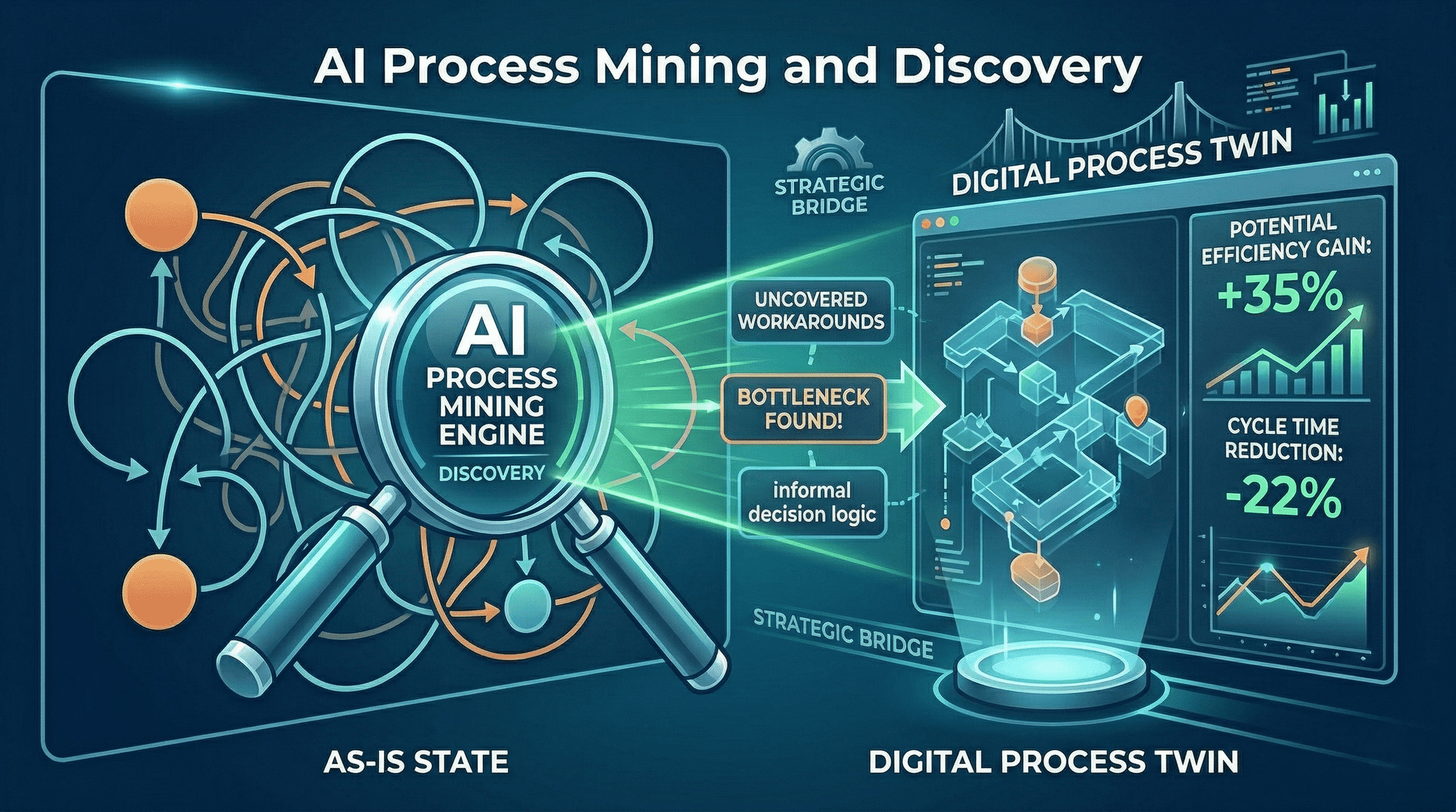
One of the most consistently underestimated challenges in enterprise transformation is process complexity. Organizations rarely know — truly know — how their processes work. They know how they're supposed to work according to the policy manual. They know the formal approval paths. What they don't know is the actual process the informal workarounds, the undocumented decision logic, the process variations across divisions and geographies, the places where people have developed elaborate compensating behaviors to address system limitations.
Process discovery — the systematic effort to understand how work actually flows before redesigning it is one of the highest-value activities a transformation program can invest in. AI is making this more tractable through process mining, which analyzes actual system transaction logs to reveal how processes are genuinely executing rather than how they're supposed to execute.
Design Before Configure: The Transformational Principle
The operational implication of the BPM imperative is straightforward but consistently violated under schedule pressure: you should complete your process design work before your technology configuration work begins, not in parallel with it.
When process design and technology configuration happen simultaneously, organizations make a series of small decisions — this is how we'll configure this field, this is the workflow we'll build that cumulatively lock in the old process patterns rather than the new ones. By the time anyone recognizes what's happened, undoing those decisions costs more time and money than the schedule pressure that caused them in the first place.
Process design leadership requires specific skills: facilitation, business analysis, cross-functional stakeholder management, and the ability to navigate the political dimensions of process change which are always present when process redesign threatens established turf boundaries or changes who has authority over what.
AI as a BPM Multiplier
AI is fundamentally changing what's possible in business process management. Process mining AI can analyze millions of transaction records to surface bottlenecks, deviations, and inefficiencies that human analysis would never find. Intelligent automation can handle rule-based process steps with perfect consistency. Natural language processing can automate document-intensive processes that previously required significant human judgment.
But these AI capabilities amplify whatever process design they're applied to. AI applied to a well-designed process produces extraordinary results. AI applied to a poorly designed process produces extraordinary dysfunction.
Process design excellence isn't just a foundational discipline — it's the prerequisite for AI transformation to deliver its promised value.
Ready to lead transformation at the highest level?
Get your copy of The AI Project Manager: A Transformation Leader's Guide to Enterprise Success on Amazon today:
https://www.amazon.com/Project-Manager-Successful-AI-Enabled-Transformation/dp/B0GRGW6TCD/ref
And visit www.theaiprojectmanager.ai for free resources, assessments, and the AI Project Manager Certification Program.