I've seen testing treated as a checkbox — a phase you go through to prove the system was built correctly, primarily useful for producing documentation that demonstrates due diligence. This approach is responsible for a significant percentage of the painful go-live experiences I've witnessed across thirty years of enterprise transformation.
I've also seen testing treated as a quality philosophy — an integrated, continuous discipline that starts at the beginning of the program and builds organizational confidence progressively through every stage. These programs go live differently. The team is confident rather than anxious. The business is prepared rather than surprised. Issues that emerge post-go-live are edge cases, not fundamental design failures.
The difference between these two approaches isn't resources — it's mindset and methodology.
The Testing Hierarchy
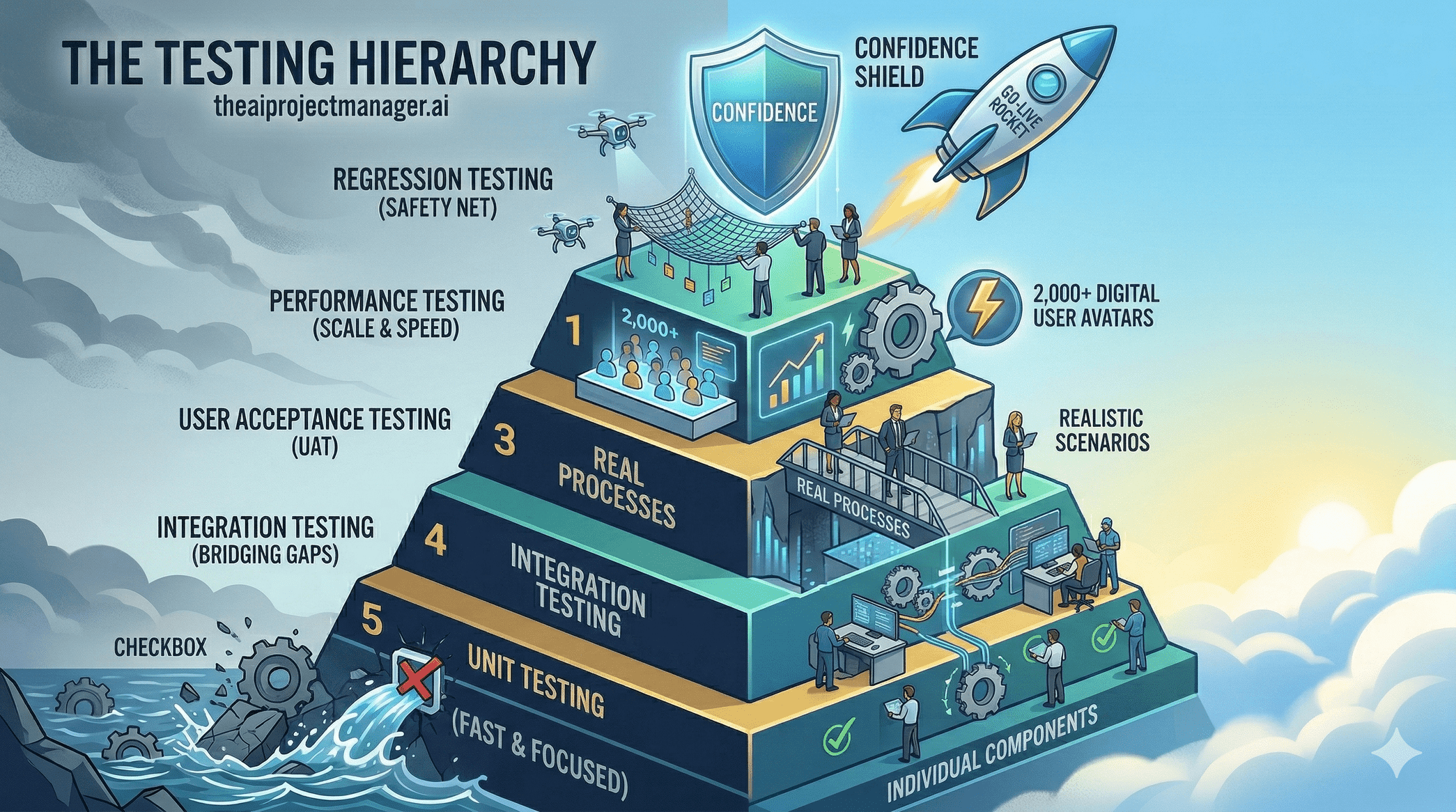
Effective transformation testing isn't a single activity — it's a progression of increasingly comprehensive validation activities, each building on the previous:
Unit Testing validates individual components: does this specific configuration, workflow, or calculation work as designed? Unit testing is fast, focused, and typically executed by technical team members.
Integration Testing validates that components work together: when the procurement process triggers the inventory update, which triggers the financial posting, does the end-to-end chain execute correctly? Integration testing is where most enterprise programs discover the gaps between what different workstreams assumed about each other.
User Acceptance Testing (UAT) validates that the integrated system supports real business processes executed by real users. UAT is where business stakeholders — not IT — confirm that the system supports how they actually need to work. The quality of UAT is directly proportional to the realism of the test scenarios and the engagement level of the business stakeholders executing them.
Performance Testing validates that the system can handle the actual volumes and response time requirements of the production environment. Many programs skip serious performance testing and discover post-go-live that what worked perfectly with 20 concurrent users breaks down with 2,000.
Regression Testing validates that changes made to fix one problem haven't introduced new problems elsewhere. In complex enterprise systems, almost every fix has the potential to affect something else. Regression testing is the safety net that catches those effects before they reach production.
The Human Side of Testing
Testing is technically a quality assurance discipline, but it's fundamentally a human challenge. Getting business stakeholders to invest serious time in UAT — when they're also expected to perform their regular jobs, when the go-live date feels distant, when testing scenarios feel abstract — is a consistent challenge.
The transformation leaders who solve this challenge don't do it through authority or schedule pressure. They do it by making the business case for testing investment clear and personal: these are the scenarios most likely to cause you pain on the day we go live. Running them now, in a test environment, costs hours. Discovering them for the first time on go-live day costs days or weeks of production disruption.
AI in Testing: A Game Changer
AI is beginning to transform testing management in meaningful ways. AI-powered test generation can create test scenarios from requirements documentation automatically, dramatically expanding test coverage. AI can analyze test execution patterns to predict which untested areas carry the highest risk. Intelligent test automation can reduce regression testing cycle times by 60-80% compared to manual approaches.
These capabilities don't eliminate the need for human testing judgment — they amplify it. The transformation leader who understands how to integrate AI testing capabilities into a coherent testing strategy will achieve quality confidence that was simply not achievable in previous generations of enterprise transformation.
Ready to lead transformation at the highest level?
Get your copy of The AI Project Manager: A Transformation Leader's Guide to Enterprise Success on Amazon today:
https://www.amazon.com/Project-Manager-Successful-AI-Enabled-Transformation/dp/B0GRGW6TCD/ref
And visit www.theaiprojectmanager.ai for free resources, assessments, and the AI Project Manager Certification Program.